

A year and a half ago, I wrote a chapter in The Radical Recall to Rest called The Edge of the Map. It was about dreams, holy imagination, mystery, and the invitation to move beyond what feels safe. At the time, I think I imagined the edge of the map mostly as a threshold. A place of possibility. A place where certainty faded and trust began. I still believe that.
But I think I understand the edge differently now. Or perhaps more honestly, I think I’ve lived there long enough to realise it isn’t quite as romantic as it first seemed.
Not because it’s bad. Not because God isn’t in it. But because eventually the shore disappears. The old landmarks stop guiding. The things that once felt clear become harder to explain. And somewhere out there, beyond the point where the map stops, you realise how much of you still wants somebody else to take over.
I’ve felt that deeply lately.
Not just with work or money or future plans, though those things are part of it. More internally than that. More quietly. I think part of me still wants somebody bigger, wiser, or more certain to sit me down and tell me exactly what to do next. To hand me a clear plan. To remove the pressure of not knowing. To reassure me that everything will work out before I fully step into it.
And the more honest I’ve become about that, the more I’ve started noticing it everywhere else too. Because I don’t think this is just my struggle. I think many of us are tired of carrying the weight of responsibility, of being human.
Waiting for someone else
You can see it in the world around us.
We expect political leaders to fix everything now. Not just governments or policies, but loneliness, anxiety, division, identity, purpose, community, meaning. Every election slowly starts sounding like people are searching for a saviour.
And then we feel disappointed when no leader can carry all of that. But maybe nobody was ever meant to.
I think deep down many of us are longing for somebody else to remove the burden of responsibility from our shoulders altogether. We want somebody to tell us what to do, what to think, how to live, and how to fix the mess. We want certainty. Clarity. A guarantee.
Me too.
Part of me still wants life to come with clearer instructions.
Part of me still wants faith to feel more certain than it often does.
Part of me still wants to know the outcome before taking the next step.
But life rarely works like that. Faith rarely works like that either.
Waiting for the Messiah
I think this longing to hand responsibility away is older than we realise.
It goes right back through the human story. We have always wanted somebody else to carry the weight of being human for us. Somebody else to fix what is broken. Somebody else to make the difficult choices. Somebody else to take over.
And perhaps that is part of why so many people placed so much hope, fear, longing and expectation on the coming Messiah.
By the time Jesus arrived, many were not simply waiting for comfort. They were waiting for someone mighty. Someone who would overthrow, restore, command, rule, and finally sort the world out from the top down. Someone who would take over the running of things. Someone who would carry the responsibility so they no longer had to.
But then Jesus came.
And He did not build the Kingdom in the way people expected.
His Kingdom was upside down. Not weaker, but deeper. Not less powerful, but less controlling. He did not come to remove us from the responsibility of being human. He came to restore our ability to love, follow, choose, and live again.
That feels important.
Because the cross is not God saying, “You no longer have anything to do.” It is God paying the price of our sin so that we can be made free again. Free not to earn His love, but to live from it. Free not to tick spiritual boxes, but to become people who can love, forgive, serve, notice, risk, surrender, and follow.
The invitation of Jesus is so simple, and yet so frightening: “Follow me.”
Not “watch me from a safe distance.”
Not “wait until I remove every uncertainty.”
Not “sit still while I do everything for you.”
Follow me.
Step by step. Day by day. In the ordinary. In the storm. Beyond the edge of the map.
Waiting for a Sign
Maybe this is what happens when the shoreline disappears.
At first, it feels like everything has gone. The old landmarks vanish. The familiar route is no longer visible. The things we used to rely on fade into darkness, and it can feel like we are completely lost.
I think this is often when we start waiting for a sign.
Something clear. Something obvious. Something that proves we are going the right way. Something that removes the risk of choosing.
Me too.
But sometimes, when the usual landmarks disappear, the older signs reappear.
The stars become visible again.
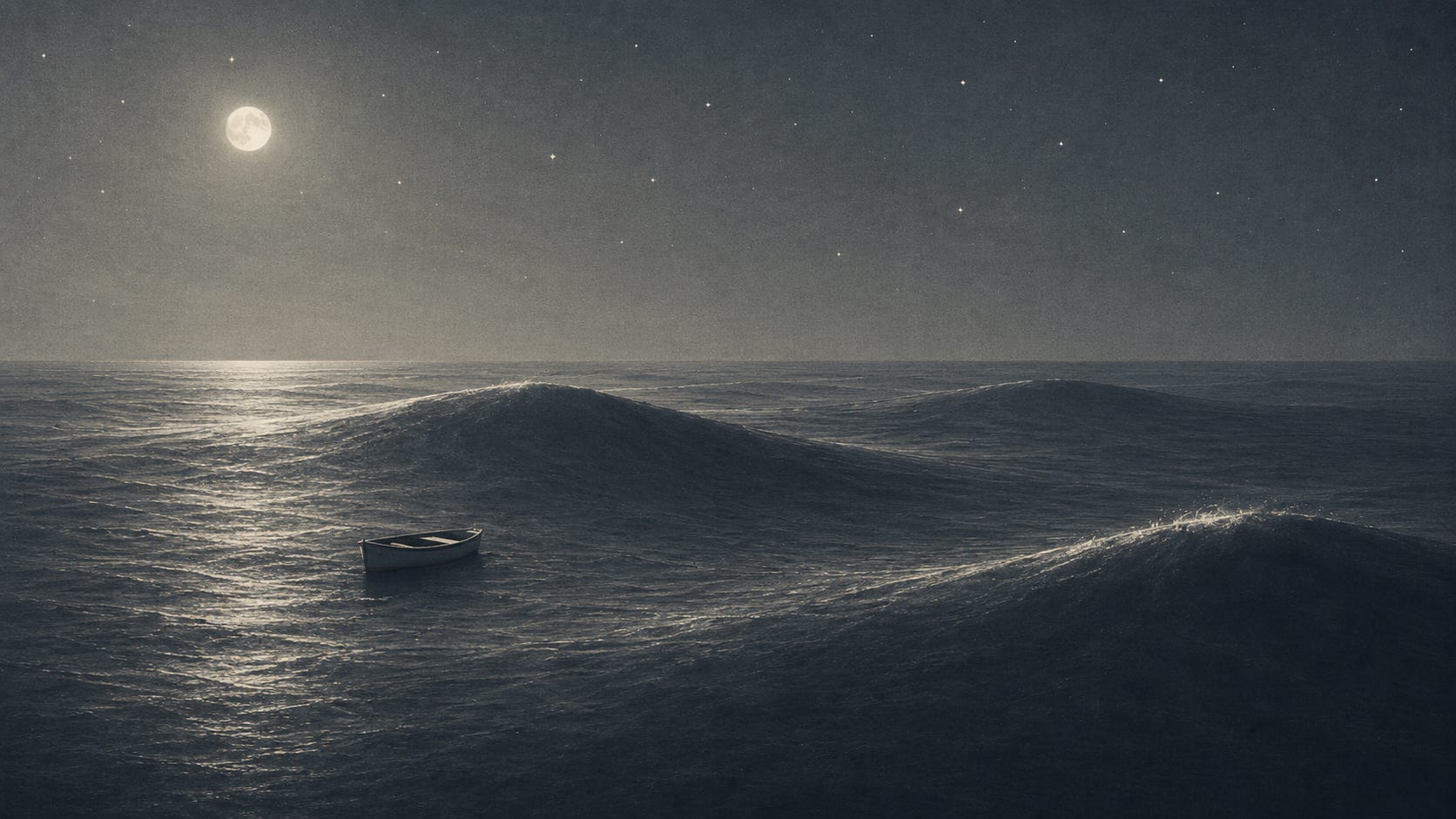
Not new signs. Original ones. Ancient ones. The ones God placed in the sky long before we drew our maps, built our harbours, named our plans, or tried to control the journey.
And maybe that is part of the gift of being beyond the edge of the map. Not that we become special. Not that we become brave in some heroic way. But that we begin to notice what was already there.
The presence of God. The breath of the Spirit. The quiet invitation of Jesus.
The next faithful step.
I think we still find ourselves wanting Jesus to fix everything by taking over completely. We want Him to take the wheel in a way that means we no longer have to face the journey. We want Him to make every decision, calm every fear, remove every risk, and steer us into certainty.
But even in the storm on the lake, when the disciples were terrified and Jesus was asleep, He did not wake up, grab the wheel, and give them a sailing lesson.
He calmed the storm.
Jesus does not always take the wheel in the way we imagine. He does something deeper. He brings peace into chaos. He reminds us who is truly Lord. He shows us that we are not alone, even when the sea is loud and the map has run out.
So maybe surrender is not giving up our responsibility.
Maybe surrender is learning to sail by the stars He has already put in place.
It is trusting Him for direction while still taking the next step. It is holding the wheel without pretending we control the sea. It is choosing to love, follow, listen, and live again – not because we have all the answers, but because He is with us.
Nobody can sail the ship for us. But we are not sailing alone. Beyond the edge of the map, the signs may not be as new as we hoped.
But the stars are still there.
Josh | A Curious Follower
Maybe you’ve been feeling some of this too.
The uncertainty. The longing for clarity. The feeling of standing somewhere beyond the old landmarks, trying to trust God one step at a time.
I wrote about “The Edge of the Map” in The Radical Recall to Rest long before I realised how much I would end up living it myself.
If this reflection resonated with you, you can explore the original chapter here.